Padukuhan Manukan Profile
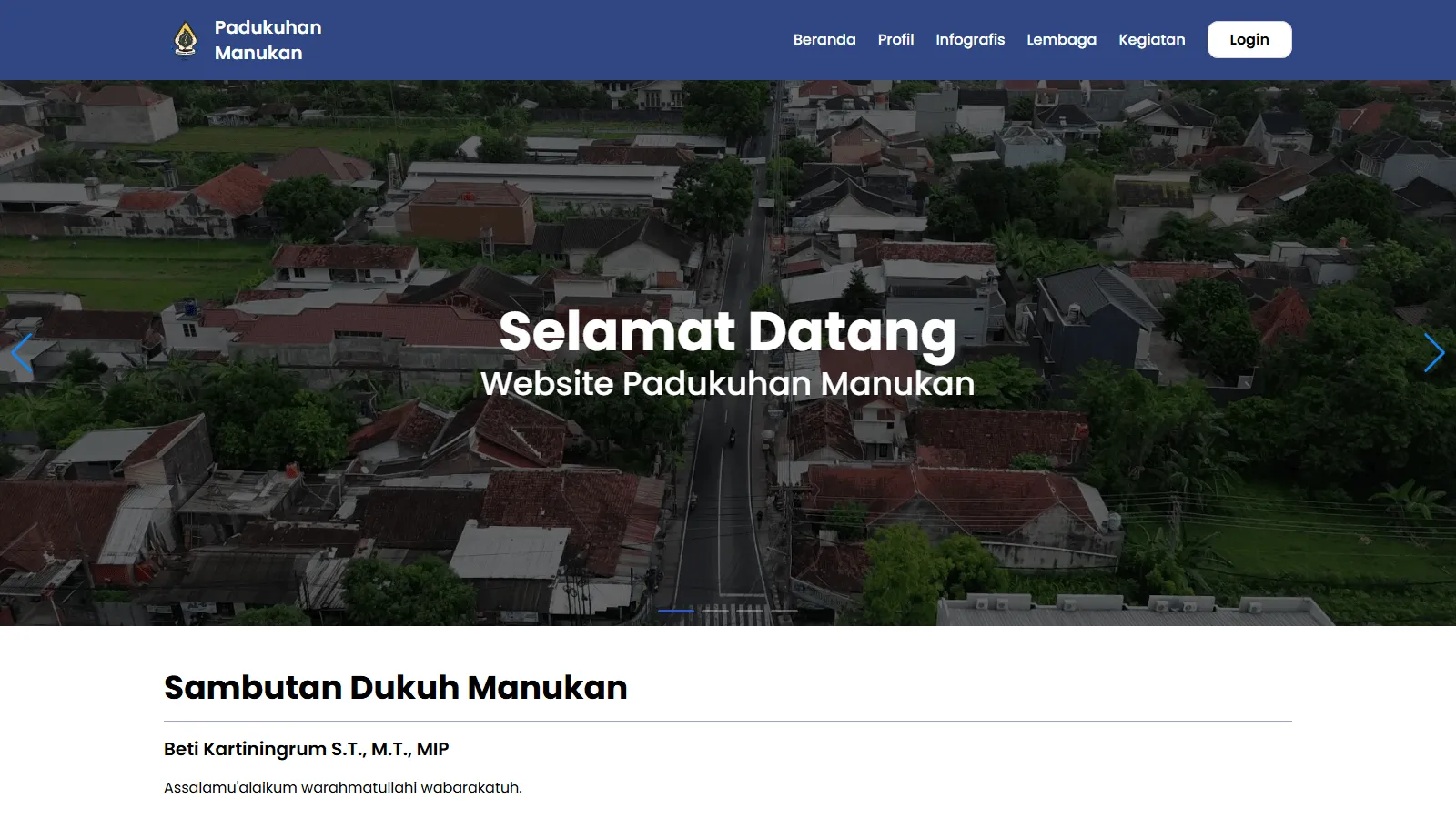
An official village profile site for Padukuhan Manukan, built during community service so residents and officials could maintain their own content without a developer.
- Role
- Front-End Developer
- Timeline
- 3 months (September — December 2025)
- Team
- Team project for the KKN community service programme. I owned the front end.
- Year
- 2025
Stack
- Next.js
- JavaScript
- Tailwind CSS
- Decap CMS
- Chart.js
- Netlify
Outcomes
- Handed over to village officials who publish activity posts themselves, with no developer involved
- Five content sections covering profile, infographics, institutions, activities and facilities
- Still in use after the KKN programme ended, which was the actual goal
Context
Padukuhan Manukan is a hamlet in Condongcatur, Depok, Sleman, in the Special Region of Yogyakarta. This site was built as part of KKN, the community service programme Indonesian students complete before graduating.
The brief from the hamlet head was specific: the village had no online presence, and its history and activities existed only as scattered documents and photos. She wanted an archive and a public identity, in her words a mirror of the hamlet’s daily life.
The problem
Most KKN websites die the moment the students leave.
The pattern is familiar: a team builds something in a few weeks, hands over a URL, and the site freezes at whatever was true on handover day. Six months later the events page still advertises last year’s Independence Day, which is worse than having no site at all.
The real problem was not building a website. It was building one that outlives the people who built it. Nobody in the village writes code, and there would be no developer to call.
My role
Team project, and I was the front-end developer. I built the interface: page structure, component architecture, responsive layout and the CMS integration that made handover possible. Other team members gathered content, photographed facilities and coordinated with village officials.
I want to be precise about scope, since it is easy to overclaim on group work. I made 41 of the 42 commits in the repository, but the content that fills those pages came from the team.
Technical decisions
A git-based CMS instead of a database
This was the decision the whole project turned on.
The obvious option was a traditional CMS with a database. I rejected it because it means a server to maintain, a database that can fall over, and eventually a bill or an upgrade nobody in the village is equipped to handle.
I used Decap CMS (formerly Netlify CMS) instead. Content lives as files in
the repository, edited through a friendly admin interface backed by
git-gateway. Officials log in, write a post, upload a photo and hit publish.
Behind the scenes that is a git commit, and Netlify rebuilds the site
automatically.
The practical consequences:
- No database to back up, secure or pay for
- Free hosting, so there is no renewal that quietly lapses
- Full version history, so a mistaken edit is recoverable
- No specialist knowledge, since the editor looks like a normal web form
Static generation
Village internet is not fast and many residents browse on mid-range Android phones. Static pages from Next.js mean the site is HTML by the time it reaches a phone, with no server round trip to wait on. Static output also pairs naturally with the git-based CMS: every publish triggers a rebuild.
Structure that matches how the village thinks
The navigation mirrors how the hamlet actually organises itself: Profile, Infographics, Institutions, Activities, Facilities. That last section maps mosques, the community hall, schools and sports fields, each with a location link, because those are the landmarks people actually ask about.
The hardest problem
The hardest part was not technical. It was designing something for editors who had never used a CMS.
My first version exposed too much. Fields for slugs, tags and metadata that made sense to me and meant nothing to a village official. Watching someone try to post an activity update, it was obvious the form was intimidating rather than helpful.
I cut it back to the minimum: title, date, photo, description. Everything else is derived automatically. The lesson was that a handover is not complete when the code ships. It is complete when someone who has never seen the admin panel can publish a post without asking for help.
Outcome
- A live official site with five content sections and around 25 images
- Village officials publishing activity updates on their own
- Zero running cost, so nothing lapses when funding attention moves on
- Still in use after the KKN programme ended
That last point is the one I care about. The measure of a handover project is whether it survives the handover.
What I would do differently
Write documentation in Indonesian, with screenshots. I walked officials through the CMS in person, which worked while I was there. A written guide would survive staff turnover; a verbal walkthrough does not.
Optimise the images properly. Photos are uploaded at whatever size the camera produced. On a slow connection that is the site’s biggest weakness, and it is the part most directly in tension with the low-bandwidth audience I designed for. Next.js has an image component that would have handled this, and I should have wired it into the CMS upload path from the start.
Add a simple content checklist. Something in the admin interface reminding editors what a good activity post contains, so quality does not drift as different people take over.